



By Joe Larano Jr.
Mike Nebres, a 38-year-old engineer from Jaro, Iloilo, arrived in Canada in the late 2010s with his wife and two teenage daughters. He came with professional training, family hope, and the determination common to many Filipino migrants who rebuild their lives in a new country. In Canada, however, credentials and experience often begin again at the starting line.
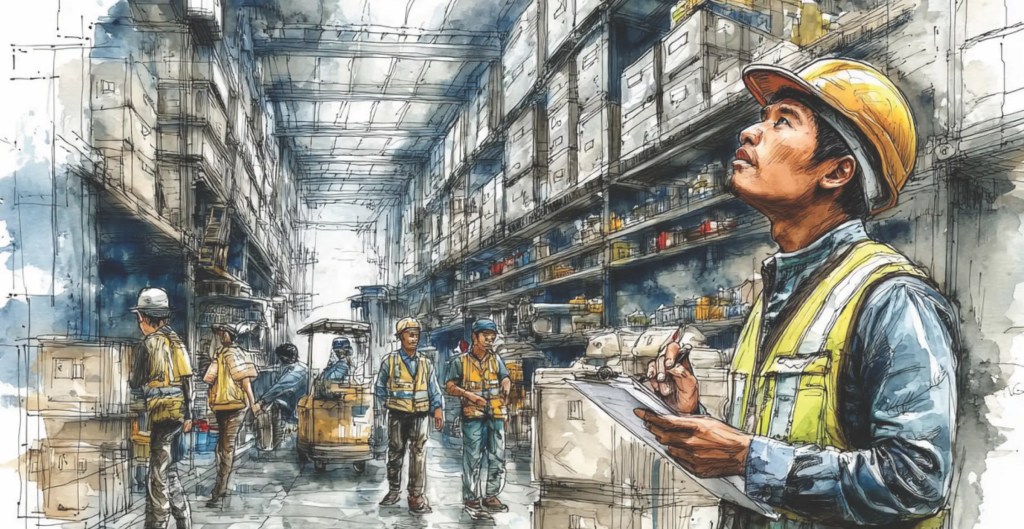
In Richmond’s industrial and business parks, where warehouses stretch like corridors of movement and precision, Mike’s first Canadian job was far from engineering. He worked as a cleaner in a large logistics facility. The transition was not easy. From reviewing technical drawings, he now found himself sweeping warehouse floors, sanitizing loading docks, and maintaining order in spaces that rarely noticed the person behind the work.
At first, he carried the weight of contrast. The idea of “going up in life” seemed distant, while daily routines placed him at the lowest operational level of the system. Yet, over time, he began to observe something important. The warehouse itself functioned like a living structure. What appeared “high” in management depended entirely on the unseen work at ground level. The saying he often heard, “What goes up must go down,” began to take on a deeper meaning.
After a few years of steady performance, Mike was promoted to maintenance assistant. The role gave him exposure to equipment systems, safety operations, and facility coordination. He applied his engineering background quietly, not as authority, but as insight. He began to understand that in every system, whether architectural or industrial, stability depended on balance between elevation and foundation. Then came an unexpected descent.
The company underwent restructuring. Mike, despite his reliability, was laid off. The rise he had begun to experience was interrupted by a sudden fall. For a family man with responsibilities, the impact was immediate. Uncertainty replaced routine. He took temporary jobs across different warehouses, often in night shifts, trying to keep stability for his family. During this period, challenges multiplied. Long working hours led to physical fatigue and recurring back pain. Emotional strain followed especially the difficulty of explaining to his daughters why stability seemed fragile despite effort and education. There were moments when he questioned whether progress in a new country was truly linear or simply cyclical.
Yet, even in this downward phase, Mike began to reinterpret the meaning of descent. He realized that falling was not always failure; sometimes it was repositioning. Like gravity in architecture, downward force was not destruction but part of balance.
Eventually, he was rehired by another logistics company in Richmond. He started again in a lower position, but this time without resistance. His previous experience allowed him to work more efficiently, and his engineering mindset helped him identify practical improvements in workflow and safety. Supervisors began to notice not just his skills, but his consistency under pressure.
Over the years, Mike progressed steadily, first into team coordination, then operations leadership, and eventually facility supervision. He became responsible for managing systems, staff, and daily logistics across a large warehouse facility. Ironically, his journey had come full circle; from working at the base of operations to overseeing the entire structure.
Still, he did not forget the earlier descent. It shaped his perspective. He no longer viewed success as a permanent rise. Instead, he saw it as a continuous movement. Like a cycle of elevation and grounding. In his mind, “what goes up must go down” was no longer a warning, but a truth about equilibrium. Every rise requires grounding. Every success is supported by unseen effort below it.
Today, Mike often walks through the warehouse floors he once cleaned. He watches operations unfold; the movement of goods, the coordination of teams, the rhythm of industry. He understands now that no position stands alone. Everything above is sustained by something below. His story is not only about rising from cleaner to supervisor. It is about understanding that life itself is shaped by both ascent and descent, and that neither defines worth without the other.
In that understanding, Mike Nebres stands grounded yet elevated in wisdom, proudly Filipino-Canadian, shaped by movement in both directions. Strengthened by the knowledge that true success is not the absence of falling, but the ability to rise with meaning after every fall.




Leave a Reply