



Posted by ReyFort Media
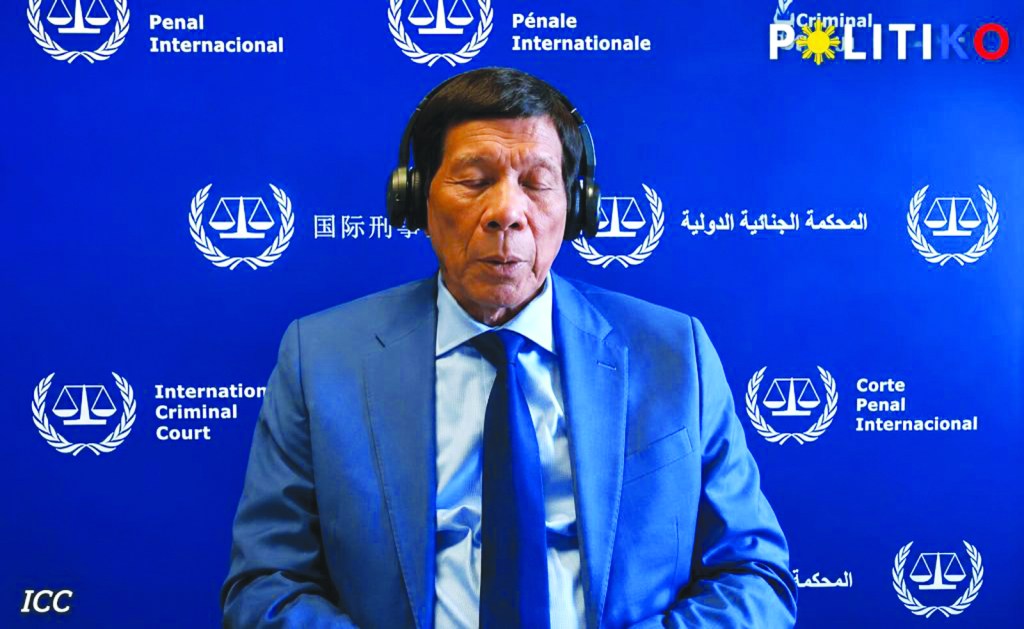
DETAINED former president Rodrigo Duterte made his second appearance before the International Criminal Court (ICC) Trial Chamber III on Tuesday for the fourth status conference in his crimes against humanity case.
Wearing a black jacket and white shirt, Duterte sat behind his lawyers and did not speak during the conference.
It was his second appearance before the Trial Chamber III, which is handling his case. He previously appeared on September 16 for another status conference. His initial appearance before the ICC was conducted via video link on March 14, 2025, before the Pre-Trial Chamber.
The status conference was part of the preparations for his trial, which is scheduled to begin on November 30.
The proceedings covered matters concerning prosecution witnesses and evidence, the disclosure of materials to the defense, and other arrangements ahead of the trial.
During the proceedings, Duterte’s lead counsel, Peter Haynes, asked the Chamber to allow the former president to receive family visits during the week his trial begins on November 30.
“The journey to Davao is 30 hours, and his family, as you know, are senior politicians — a congressman, a mayor, and a student — and they arrange their visits to him a long time in advance. You know from the medical evidence you have received how important family visits are to his mental welfare,” Haynes told the Chamber, which was presided over by Judge Joanna Korner.
The Chamber has earlier ruled that the 81-year-old Duterte was fit to stand trial for crimes against humanity stemming from his administration’s bloody anti-drug campaign.
The ruling cited the findings of an independent panel of medical experts engaged by the Chamber, as well as submissions from the parties involved in the case.
Also during Tuesday’s status conference, senior trial lawyer Julian Nicholls disclosed that the Office of the Prosecutor intends to present five witnesses before the end of the year.
“Three witnesses are expected to testify in person in court unless something unforeseen happens, “Nicholls told the Chamber.
He said two witnesses will be presented under Rule 68 (3) of the ICC Rules of Procedure and Evidence. The rule allows the admission of a witness’ prior recorded testimony when the witness is present before the Trial Chamber and available for cross-examination.
The rule is frequently used to streamline court proceedings by permitting recorded or written statements to take the place of oral testimony.
RECORDED TESTIMONIES
Meanwhile, the Office of the Prosecutor of the ICC has asked Trial Chamber III to admit the prior recorded testimonies of three additional witnesses in Duterte’s crimes against humanity case.
In a 14-page filing dated October 7 made public early Tuesday, the prosecution identified P-1370, P-1393 and P-1416 as potential witnesses whose previously recorded testimonies concern alleged extrajudicial killings in Central Luzon and the contextual elements of crimes against humanity.
“Their evidence is particularly relevant to murders, including under Count 3, committed by members of the Philippine National Police in the municipalities of San Jose del Monte in Bulacan and another undisclosed location, and to the policy to ‘neutralize’ through violent crimes, including murder, alleged criminals in the Philippines,” the prosecution said in its filing signed by acting Prosecutor Mame Mandiaye Niang.
“The three witnesses further provide evidence of the circumstances surrounding killings by members of the PNP,” it added.
Count 3 refers to the alleged murders and attempted murders of at least 45 victims during barangay clearance operations under Duterte’s anti-drug campaign, better known as Project Double Barrel.
The campaign was implemented under then-PNP chief and now Sen. Ronald “Bato” dela Rosa, who remains in hiding following the ICC’s issuance of an arrest warrant against him.
The prosecution said that the proposed evidence of P-1393 also shows that police officers supposedly involved in the killing of an alleged drug pusher did not face disciplinary action.
On the other hand, it said that “P-1393’s Prior Recorded Testimony goes to proof of a policy to ‘neutralize’ through violent crimes, including murder, alleged criminals in the Philippines. It also provides evidence of the police’s modus operandi in the charged crimes.”
It added that the three witnesses’ prior recorded testimonies concerning the contextual elements of crimes against humanity, particularly the alleged policy of neutralizing criminals through violent acts, including murder, were cumulative and corroborative of other evidence.
“Therefore, their testimonies are relevant, reliable, and probative,” the prosecution said, adding that their accounts of the killings could be corroborated by other witnesses.
The prosecution said that admitting the three witnesses’ prior recorded testimonies would not prejudice Duterte or violate his rights, considering the nature of each witness’s testimony.
It added that the defense would still be able to cross-examine other witnesses testifying orally in court based on information contained in the recorded testimonies, present contradictory evidence during its case, or challenge the weight given to the recorded testimonies if discrepancies with other evidence emerged.
Meanwhile, the prosecution has restructured its List of Evidence in the case against Duterte and have so far removed 253 items.
Niang said the move would “provide a clearer understanding of the categories of evidence the prosecution seeks to rely upon.”
He added that they could could likewise remove nearly 7,000 more items if the defense agreed to its proposed stipulated facts concerning a specific collection of evidence. (A. Hachero/ Malaya)




Leave a Reply