



By Carlito Pablo
The contest for the next president and vice president of the Philippines is far from decided.
Even though Vice President Sara Duterte continues to lead surveys among likely presidential contenders, it doesn’t look like the 2028 campaign will be a walk in the park for her.
A couple of recent releases by OCTA Research indicate that that she is not unbeatable as previously thought.
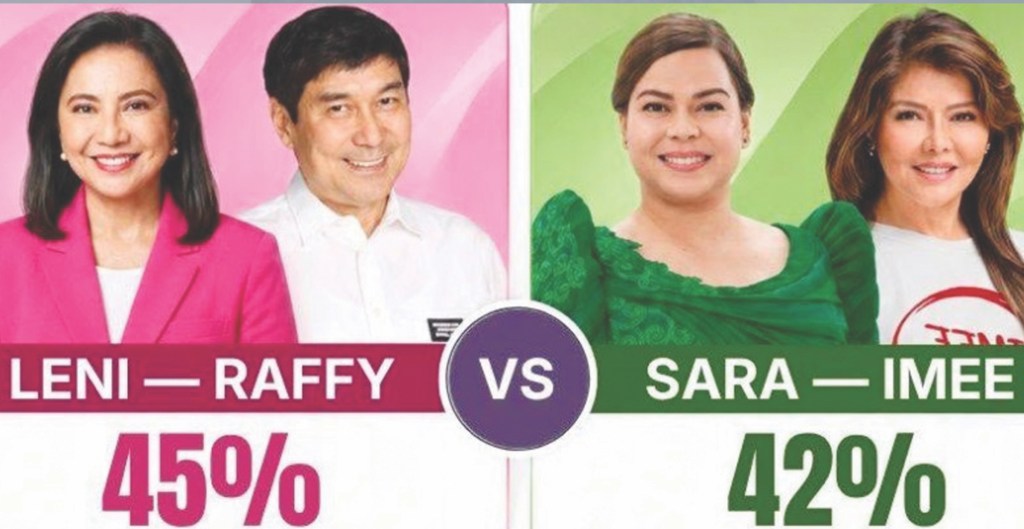
An August 12, 2026 report by the Quezon City-based polling firm shows a statistical tie between a hypothetical tandem by former vice president Maria Leonor “Leni” Robredo and Senator Rafael “Raffy” Tulfo and a potential ticket by Duterte and Senator Maria Imelda “Imee” Marcos, for president and vice president, respectively.
Based on OCTA Research’s Tugon ng Masa (TNM) survey, a Robredo–Tulfo tandem got the support of 45 percent of respondents nationwide, compared to 42 percent for a Duterte–Marcos tandem.
Meanwhile, eight percent of respondents polled from July 4 to July 11, 2026 indicated that they would vote for neither tandem, four percent are undecided, and one percent refused to answer.
The survey has a margin of error of plus or minus three percent, meaning the three percent lead by a Robredo-Tulfo ticket is “not a reliable signal of who is actually ahead”.
Per OCTA Research’s release, the “race is statistically a toss-up”.
For context, the polling firm noted that this is “nonetheless part of a dramatic multi-quarter shift for this match-up”.
Specifically, prior TNM rounds had shown Duterte–Marcos leading Robredo–Tulfo by roughly 15 to 25 points.
By the first quarter of 2026, Robredo–Tulfo had “not only closed that gap but moved into an apparent 4-point lead of its own (44% versus 40%) — the first time in the TNM series that a
Robredo-led tandem had numerically topped Duterte–Marcos”.
Based on the most recent survey, that “apparent lead compressed further to 3 points (45% versus 42%)”.
These results had political columnist Marlen V. Ronquillo speculating that the “political ground may have shifted”.
“It is just one poll and maybe an outlier, a fluke. But it is an indicator that maybe, just maybe, there are other possibilities in 2028 that do necessarily involve the coronation of Sara Duterte as the new president,” Ronquillo wrote in his August 16, 2026 column.
Titled “Calcified presidential polling hits a wall”, the piece by the Manila Times opinion writer
was referencing Robredo’s refusal to run for president in 2028 and that this stance may have been shaped by Duterte’s strong showing in previous surveys.
Robredo first ran for president in 2022 but lost to Ferdinand Marcos Jr., brother of Duterte’s ally Imee Marcos.
“So, those hoping that Robredo would change her mind and run anew for the sake of a country hungry for competent and honest leadership have harbored this hope: for the calcified polling to hit a brick wall, then shatter the aura of political invincibility built around Sara Duterte. Maybe that will push Robredo into reconsidering her decision not to embark on a second presidential run,” Ronquillo wrote.
In the first week of August, OCTA Research released a “2028 Presidential Political Map”, using the results of its July 4-11 Tugon ng Masa nationwide survey.
Nationally, according to the polling firm, Duterte leads a hypothetical matchup with Robredo, 43 percent to 34 percent.
“But the more important number may be the 22% who remain undecided, favor neither candidate, or declined to answer — a bloc larger than Duterte’s 9-point lead.”
OCTA Research concluded, “The race remains fluid, and preferences can still shift considerably before 2028.”
The map also “reveals distinct regional preferences”.
“Duterte commands overwhelming support in Mindanao and holds an advantage in the Visayas, while Robredo remains strongest in Balance Luzon. Metro Manila has emerged as the country’s most competitive battleground — both candidates tied at 34%, with nearly one in three voters undecided.”
Hence, according to OCTA Research, “The challenge for any contender will be expanding
beyond a traditional base while winning over the country’s large undecided bloc.”
CAPTION: For photo caption: Graphic by OCTA Research on where the two hypothetical 2028 tandems stand with the public.




Leave a Reply