



By Joe Larano Jr.
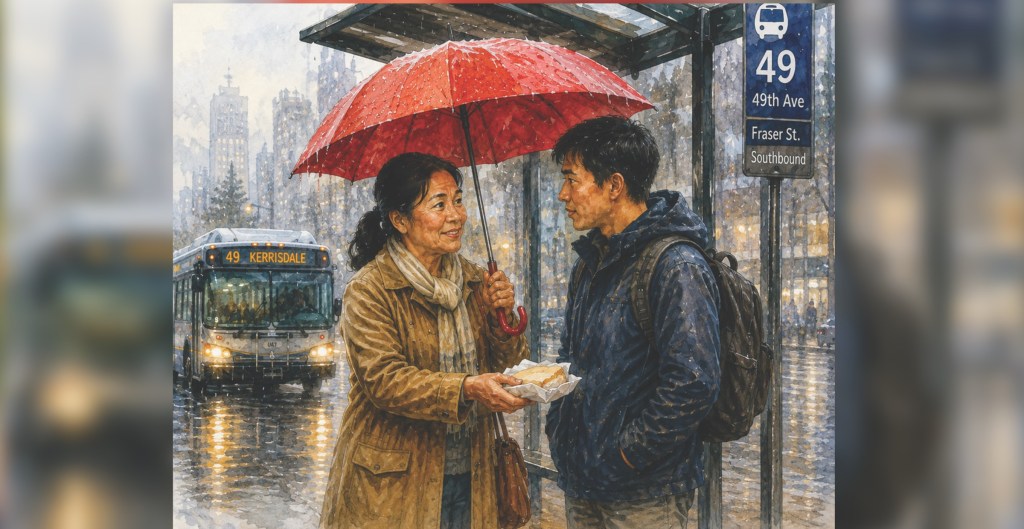
Every Tuesday morning, a red umbrella appeared at the corner of Fraser Street and 49th Avenue in Vancouver. Beneath it stood Elena, waiting for the Number 49 bus. She had been in Canada for almost nine years, working as a caregiver for an elderly woman in Kerrisdale. Back in the Philippines, Elena had been a high school teacher for nearly twenty years. She had taught literature, encouraged young minds and stood before classrooms filled with students. In Canada, she prepared meals, cleaned the house and helped her employer with the routines of everyday life. She had learned not to measure her worth by the job printed on her name tag. Her two children were finishing university in the Philippines, and every month she sent money home. The red umbrella was her small companion through Vancouver’s long, grey winters.
One rainy morning, a young man approached her at the bus stop. He was holding a piece of paper with an address written on it. He was going to his first job interview in Canada. His hands were trembling. Elena gave him directions and then said, “Remember, they are not doing you a favor by giving you a job. You are also giving them your skills, your time and your effort.” The young man looked at her curiously. “Are you a teacher?” Elena smiled. “I used to be.” He did not get the job. A few weeks later, Elena saw him again at the same bus stop. He looked exhausted. He had applied for more than twenty jobs, but every employer wanted Canadian experience. He wondered aloud if coming to Canada had been a mistake.
Elena shared half of her sandwich with him. Then she said something she had told thousands of students during her years as a teacher: “Don’t let one country’s definition of your experience become your definition of yourself.” Before they parted, she wrote the name of a community college and a technical program on the back of her bus ticket. “Try this,” she said. “Sometimes we have to take another road before we find the right one.”
They never saw each other again. Elena continued working, caring for her elderly employer and sending money home. Her children urged her to return to the Philippines. But Elena had begun saving quietly. Every Tuesday, she placed a little money into an envelope hidden inside her desk. She was not saving for a house or a car. She was saving for a classroom. When her employer eventually passed away, Elena enrolled in a program that helped internationally educated teachers work with newcomer students. It was not easy. She had to study again, complete assessments and overcome the familiar feeling of having to prove herself all over again. But she persisted.
Eventually, Elena began volunteering at a community learning center in East Vancouver. One of her students was a young woman who had been a teacher in her own country but was now cleaning houses. One afternoon, the young woman stayed behind and confessed that she was thinking of giving up and going home. Elena opened her drawer and brought out the old red umbrella. It was faded, with a small tear near one of the ribs. “This umbrella has seen me cry,” she said. “It has seen me get rejected. But it also saw me keep going.” She placed it in the young woman’s hands. “Take it. You don’t need it forever. Just until you find your own.”
Months later, the young woman returned. She had found work in her profession. She placed the red umbrella on Elena’s desk. “I think I don’t need this anymore.” Elena smiled. “Good. Then give it to someone else.” At that moment, the young woman understood. The umbrella was never really the gift. Courage was.
That evening, Elena walked home through the Vancouver rain without an umbrella. She did not mind getting wet. She finally understood that when immigrants cross an ocean, they do not really start from zero. They bring their knowledge, memories, sacrifices, failures and the strength they gained from surviving them. And sometimes, while we are struggling to find our own place in a new country, we unknowingly become the shelter someone else needs. Perhaps that is how hope survives among immigrants. It is passed from one tired hand to another, until someone finally finds the courage to walk forward on their own.








Leave a Reply