



By Joe Larano Jr.
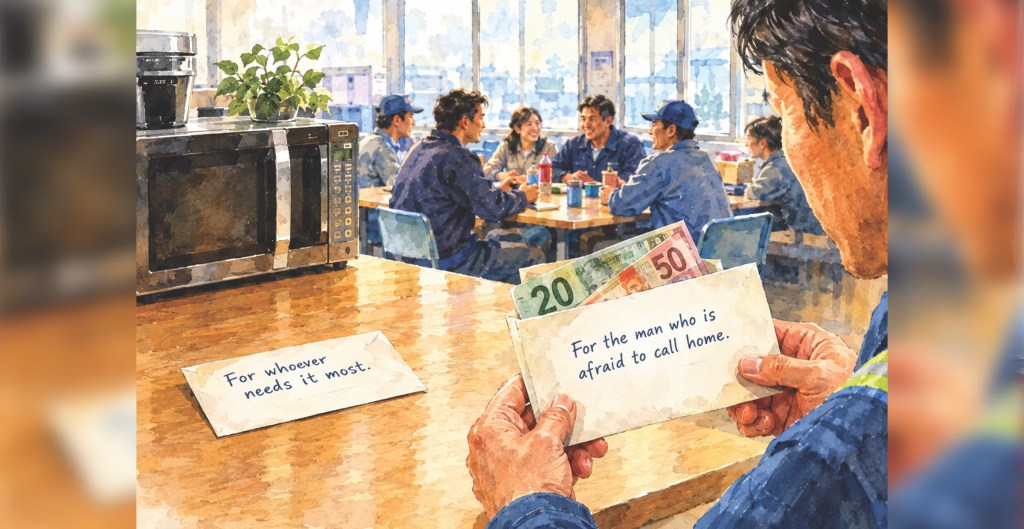
Every Friday morning, someone left an envelope on the table beside the microwave in the lunchroom of a manufacturing plant in Surrey. There was never a name on it, only a handwritten note: “For whoever needs it most.” Sometimes it contained twenty dollars, sometimes fifty. Nobody knew who was leaving them. The Filipino workers had their theories, but no one really cared to investigate. They simply knew that the envelopes had helped several people. A newcomer whose first pay cheque was delayed had used one. A single mother had taken another when her child needed medicine. Ramon, who had worked at the plant for seven years, never paid much attention to the mystery. Like many Filipino workers in British Columbia, he worked steadily, sent money home and tried to make whatever remained of his pay cheque last until the next one.
Then one Friday morning, Ramon found an envelope waiting on the table. The message was different: “For the man who is afraid to call home.” He froze. That very morning, his younger brother in the Philippines had been hospitalized, and his family needed money. Ramon had already sent most of his pay cheque home and had spent the previous night staring at his bank balance, wondering what he could do. He picked up the envelope but did not open it. After a long moment, he put it back and returned to work. During lunch, it was gone. Beside the microwave was another note: Thank you. Ramon became curious. He asked around and learned that the envelopes had been appearing for almost a year. Nobody knew who had started them. Finally, he asked his supervisor if they could check the security camera.
The footage revealed something nobody expected. Every Friday, before the workers arrived, an elderly Filipino maintenance worker named Mang Tony would quietly enter the lunchroom carrying a small paper bag. Ramon knew him well. Tony had retired several months earlier. When Ramon called him, the old man finally explained. Years ago, when he had first arrived in Canada, Tony had worked nights cleaning offices. One morning, he found an envelope containing fifty dollars in his locker. There was no name and no explanation. He never discovered who had left it. “I was too proud to ask for help,” Tony told Ramon. “But that envelope helped me survive that month. More than the money, it taught me that somebody cared.” When Tony finally had enough to give back, he decided not to look for the stranger who had helped him. Instead, he would help someone else.
The following Friday, Ramon arrived early. He placed an envelope on the same lunchroom table. Inside was twenty dollars, the most he could spare. On the outside, he wrote: “For whoever needs it most.” Then he added, “Someone helped me once. I don’t know who. So, I’m helping you.” He walked away before anyone arrived. That evening, his family called from Manila. His brother was improving, and relatives had managed to help with the immediate expenses. Ramon sat quietly after the call, thinking about the envelope he had refused to take. He realized that the money had never been the real miracle. It was the kindness behind it, passed quietly from one person to another.
Perhaps this is one of the things that makes the Filipino immigrant experience different. We leave home searching for a better life, carrying our dreams in one hand and our responsibilities in the other. We work, send money home, worry about our families and sometimes wonder who will help us when our own strength runs low. But somewhere along the way, someone reminds us that we are not alone. A little kindness can cross oceans. It can survive years, change hands and continue long after the person who started it is forgotten. We may not always be able to solve another person’s problems, but we can make their burden a little lighter. And sometimes, that is enough to keep someone going. (contact: jblarano@gmail.com)




 ReyFort Media
Leave a comment