



By Carlito Pablo
Is Canada prepared for a military confrontation with China in defence of the Philippines and Taiwan?
This question was posed by a former diplomat in an article on Open Canada, the online magazine by the Canadian International Council, a foreign-affairs think-tank.
Jan Top Christensen, a retired ambassador of Denmark and whose postings include the Philippines, authored the piece examining the risks of closer military ties between Canada and the Philippines.
In his article titled “China and the Philippines: Strained Neighbourly Relations and the Canadian Connection”, the former envoy cited in particular the visiting forces agreement in Manila last year.
“When Canadian Defence Minister David McGuinty signed a status of visiting forces agreement (SOVFA), with the Philippines in November 2025, he may have inadvertently moved Canada closer to military involvement in the South China Sea (SCS),” Christensen wrote.
“Is Canada ready for this?” the former diplomat asked in his piece published on January 5, 2026.
A media release by Canada on the day of the SOVFA signing noted that the agreement “marks a new chapter in Canada-Philippines defence cooperation, enabling greater engagement, cooperation, and collaboration between both nations”.
“It will allow the Canadian Armed Forces and the Armed Forces of the Philippines to work more closely together through participation in joint and multinational operations and exercises in each other’s territories,” explained the release dated November 2, 2025.
Now based in Canada, Christensen noted, the “agreement itself innocently makes it easier for Canada to participate in bilateral and multilateral military drills in the Philippines”.
“But what could be the risks of closer cooperation further down the road?” the former diplomat asked.
The Philippines and China have competing claims over areas in the South China Sea (SCS).
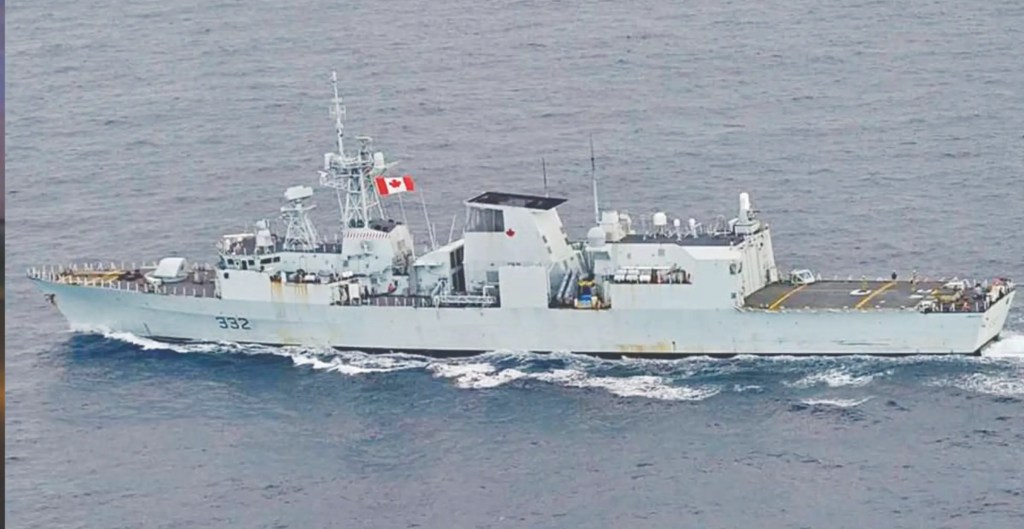
“Would it be in Canada’s national interests to help defend Philippine claims to fishing grounds in the SCS? It may seem farfetched but in October 2022, naval ships belonging to Canada, the US, Japan, and Australia were already conducting exercises in the SCS for the first time together,” Christensen wrote.
Christensen noted that Canada’s 2024 defence policy states that, “as a Pacific nation, the security and stability of the broader Indo-Pacific region is vital to Canada’s future. It is the world’s fastest growing region and home to six of Canada’s top 13 trading partners”.
He also noted that some observers predict that China may try to invade Taiwan in 2027.
“In a meeting in Ottawa in November, [former Canadian diplomat] Michael Kovrig’s assessment was that ‘a direct military confrontation between China and the US over flashpoints such as Taiwan and the SCS is not impossible within five years’,” Christensen related.
Considered by China as a breakaway province, Taiwan also claims certain parts of the South China Sea.
Meanwhile, Washington has repeatedly said that it is obligated to defend the Philippines under the two countries’ 1951 Mutual Defense Treaty if Filipino forces, ships and aircraft come under armed attack, including in the South China Sea.
Christensen recalled that U.S. Secretary of War Pete Hegseth has said “without mentioning China by name, that the defence agreement between the two countries covers third-party attacks on military and civilian ships in the Pacific and the SCS”.
As well, a Chinese foreign ministry spokesperson criticized the U.S. and the Philippines, saying Washington is using Manila as a “proxy to provoke confrontation and escalate tensions in the region”.
“In such sharpened scenarios, the danger may be that Canada could become collateral damage if tensions increase in the SCS,” Christensen wrote.
“That said,” he continued, “we should not be that surprised if this was to happen as the 2024 defence policy also noted that Canada would continue to promote stability in the Indo-Pacific region ‘by maintaining a more persistent presence and helping support regional defence’.”
“If an open military confrontation erupts with China, what could be Canada’s involvement? Using navy ships and other military forces visiting the Philippines or the region? We are not at this serious stage, yet. But what if…?”





 ReyFort Media
Leave a comment