



By Rosette Correa
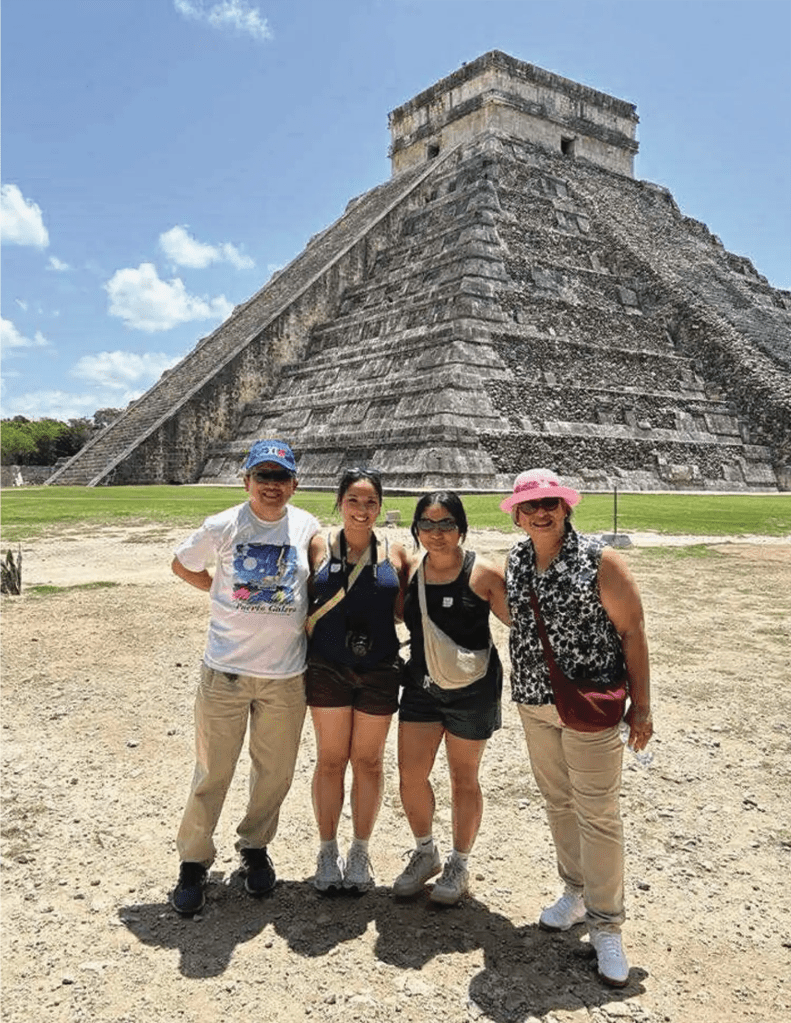
Sun bleached sand and turquoise waves were supposed to silence the overworked part of my brain during a quick getaway to Cancún after a long school year. Instead, each excursion beyond the hotel zone—into the shadowed limestone of the cenotes and the hieroglyph scrawled temples of Chichen-Itza—amplified a question I had never fully faced: why do the voices of the ancient Maya echo in ruins and reconstructed museum labels, while my own Filipino mother tongue still fills kitchen conversations 7,400 miles away? Spain ruled both archipelago and peninsula for three centuries, baptizing islands and jungles alike, yet Tagalog survives as a national language whereas classic Maya survives mostly in glyphs scholars decipher.
The contrast nagged me between mezcal tastings and latenight conversations with my husband who was interested in finding out more about his Mexican roots. Was geography decisive—our scatter of islands less penetrable than the Maya’s continuous homeland? Did friars in Manila nurture local scripts they hoped to sanctify, while Diego de Landa burned codices outside Mérida? My vacation photographs grew footnotes, demanding that leisure become inquiry. My beach holiday unraveled into a comparative meditation on colonial tactics, linguistic resilience, and the fragile architectures—stone or syllable—that hold memory upright for nations weathering waves of empire. Like Xiao Chua, Ambeth Ocampo, Randolf David and others, I went into an anthropological and sociological rabbit hole (or in this case a cave with bats and crisp, clear waters), and bathed in the analogies of a culture that I know so well and one that I felt close kinship to, thus, my dive into the comparative nature of this article.
There is no one answer to the historical, sociological and political comparisons and contrasts between the Philippines and Mexico, thereby represented by the Yucatan peninsula and its indigenous peoples, the Mayans. This article, though, tries to see these comparison and contrasts for what they are in the most simple form.
Geographical Fragmentation and Isolation
The Philippines is an archipelago of over 7,000 islands, which made centralized colonization difficult. Spanish control was concentrated in urban centers (e.g., Manila, Cebu), and many islands and upland areas retained their local governance, languages, and customs.
In contrast, the Maya inhabited contiguous territory, which was easier for the Spanish to conquer and integrate into colonial systems.
Spanish Colonial Strategy: Use of Local Languages
Catholic missionaries in the Philippines learned and used local languages (like Tagalog, Cebuano, Ilocano) to evangelize. Spanish colonizers rarely imposed the Spanish language on the masses; it remained largely a language of the elite and clergy. In Mexico, especially in central and southern regions, Spanish language replaced indigenous languages more aggressively in public, religious, and educational life.
No Massive Indigenous Empires in the Philippines
The Philippines had decentralized chiefdoms (barangays), not a unifying empire like the Aztec or Maya. In Mexico, the Spanish quickly toppled centralized indigenous states, taking over their bureaucracies, infrastructure, and trade routes. In the Philippines, the lack of a central political structure made total cultural replacement less practical.
Catholicism and Syncretism
Filipinos blended indigenous beliefs with Catholic practices, creating a syncretic culture that preserved native worldviews within a Christian framework. Rituals, festivals (like pahiyas or Ati-Atihan), and even saints were localized and given pre-Hispanic meanings. In contrast, many Maya religious and cultural practices were violently suppressed, especially by zealous friars and inquisitors (e.g., Diego de Landa burning Mayan codices in the 1560s).
Continuous Resistance and Resilience
Filipino groups, especially those in remote or mountainous areas (e.g., the Igorot, Lumad, and others), resisted Spanish control for centuries. Lapu-lapu is an excellent example of this resistance to foreign rule. Some of the most indigenous Filipino cultures were never fully Christianized or colonized. Our brothers and sisters in the south remain Muslim because of this act of resistance. Maya resistance did occur (notably the Caste War of Yucatán, 1847–1901), but it was met with far more militarized and genocidal suppression. The conquistadors, after burning the Mayan codices, made sure that none of the Mayan descendants who have the knowledge of their culture, remained, from the elders to their newborns.
How did Filipinos keep their culture and language intact?
The use of native language in religion and education early on, assured the Filipino its adherence to its ways of life and culture. Early catechisms, grammar books, and even dictionaries were written in Tagalog and other native tongues. This formalized and preserved these languages. Oral traditions and folk arts such as indigenous oral storytelling, dance, music, and poetry (like kundiman, balagtasan, epic chants) were passed down through generations. These traditions carried cultural memory even when written history was lost or censored.
There was cultural flexibility and Filipinos adapted colonially introduced customs and made them their own (e.g., fiestas, bayanihan, utang na loob), embedding them within native values. There was also a resilient local identity that despite Spanish influence, most Filipinos continued to identify more with their ethnolinguistic groups (e.g., Ilocano, Visayan, Waray) than as “Spanish” or “Filipino” until much later.
Of course, after Spain, the U.S. promoted English, ironically preserving native languages by bypassing Spanish as a dominant tongue. This delayed full linguistic assimilation and kept Filipino identity distinct.
Many social scientists and historians agree that what makes us unique is our ability to assimilate and make good what we have been handed. Anthropologist Nestor Castro notes that Filipino culture is a “hybrid construct,” deeply influenced but not erased by colonization. Sociologist Randolf David has observed that Filipino identity is rooted more in community, kinship, and language than in centralized political structures — a strength in resisting cultural erasure. In contrast, scholars of Latin America point out that the destruction of Mayan writing systems, education, and political centers created a massive break in cultural transmission.
So what came out of this trip? As a Filipino, there was instant kinship, a kapwa, with the general Mexican people and the native Mayans. It helped that I was racially ambiguous in presentation, having a Spaniard for a mother and a Filipino for a father. People approached our entire family of five with “Buenos dias” and assumed we spoke Spanish and started conversing with us in that language. There was, however, a natural tendency to embrace the culture that was there, as historically our two lands are brothers, and we have had this kinship for centuries.
Now, I do regret not taking my Spanish required courses in college seriously, but my broken Spanish got me food and drinks, and on this vacation, that’s all that I needed. When the people did find out we were Filipino and some of them knew of our connection, it was like brothers seeing each other face to face after a long time and having a bond that went beyond language. It was a bond of indigenous cultures that survived difficulties and challenges but arose from them; two cultures who did not waste time mulling over the losses, but stood up, dusted themselves, and made do with the fortunes that they had, never looking back to blame others for their misery. These are two peoples who thrive on what they have discovered and rediscovered about themselves and their connections to each other and to the lands that, although were an ocean apart, did not stand in between a kinship that God had forged for them.
(By Rosette Correa). Photos
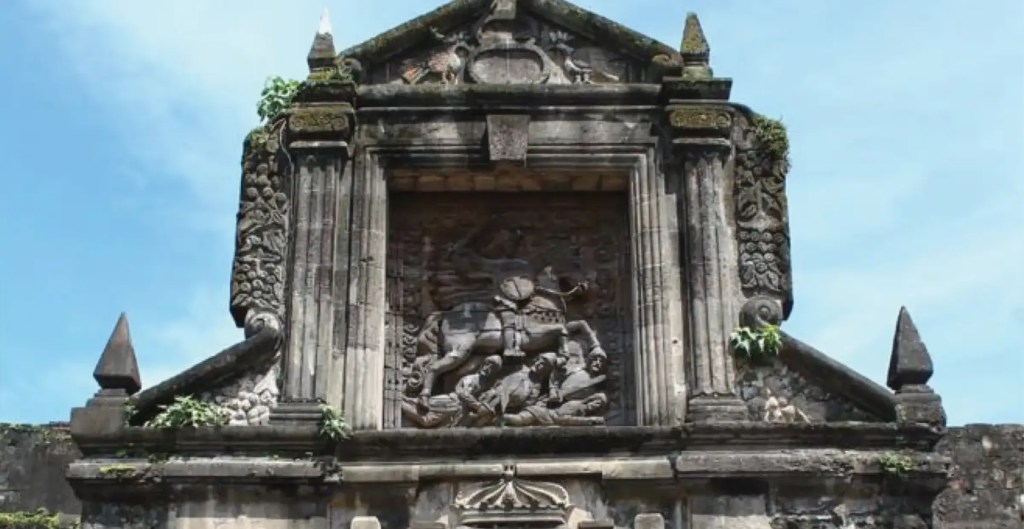
Chichen-Itza Temple and detail (bottom photo); Fort Santiago facade (Featured image)


 ReyFort Media
Leave a comment