



By Joe Larano Jr.
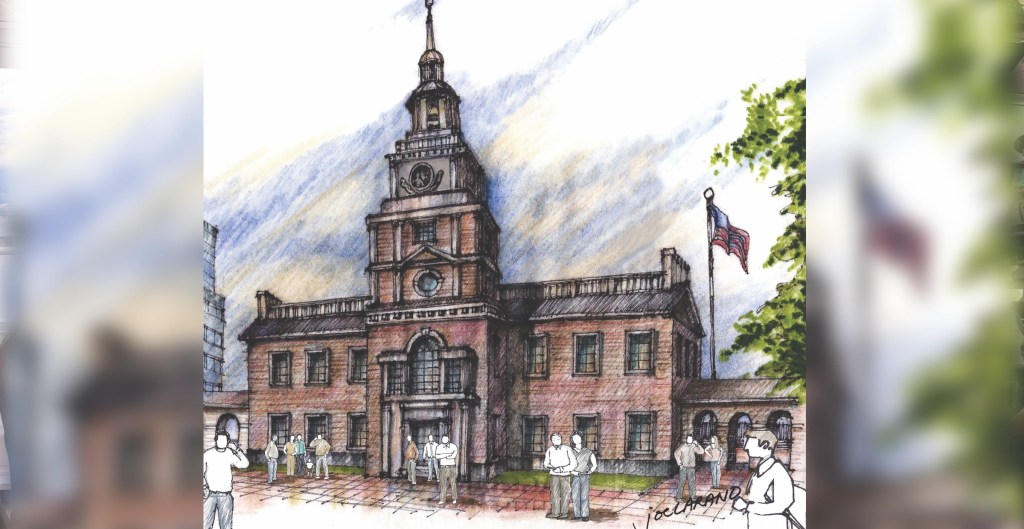
As we slowly moved into the hall of the building once known as the Pennsylvania State House, a uniformed staff member from the National Park Service—our tour guide for the afternoon—introduced himself and asked where we were from. “We’re from Canada, from British Columbia!” I answered proudly. I’ve always believed the Great White North to be one of the world’s truly great nations. Canada’s greatness isn’t just in its vastness—it is the second-largest country in the world—but also in its reputation as one of the most welcoming and culturally diverse societies on the planet. I quickly found a spot by the railing, securing a clear view of the historic chamber where representatives of the thirteen original British colonies boldly declared independence in 1776 and laid the foundation for what would become the United States of America.
There was something surreal about standing in that hall—a space etched into the annals of human history. The wooden chairs, the long green-covered tables, the ink pots, and the creased papers under glass gave off a strong sense of presence, as if the ghosts of Jefferson, Adams, and Franklin might still be lingering. It was easy to imagine the tension, the gravity, and the determination that must have filled that room two and a half centuries ago. The tour guide began his narration, highlighting key moments and figures, weaving anecdotes with historical facts. His passion was evident, although occasionally interrupted by the faint sound of protest chants from beyond the building’s walls.
A muffled voice echoed in the distance, chanting, “Make love, not tariff war.” It caught everyone’s attention, including that of our guide, who paused momentarily and offered a restrained smile that hinted at mild disapproval. I could sense his unease—not at the protest itself, perhaps, but at how its message clashed with the solemnity of the historical site. For my part, I wasn’t particularly inclined to dwell on the tariffs imposed by the Trump administration or the retaliatory measures then being considered by the Canadian government. I was more concerned with the heat that afternoon, the slight ache in my legs, and a growing hunger that made me long for an authentic Philly cheesesteak, for twhich Philiadelphia is well-known.
After the tour concluded, we stepped out into the bright sunlit courtyard. I paused for a moment, turned back, and looked at the building’s brick façade—simple yet dignified. In that moment, I realized how this place, while a tourist site now, was once the crucible of radical thought, rebellion, and ultimately, nation-building. The irony wasn’t lost on me that just beyond its historic walls, modern protestors were exercising the same freedoms the Founding Fathers had fought for—freedom of speech, the right to dissent, the courage to challenge authority.
We found a nearby food stall bustling with locals and tourists alike. As I bit into the savory cheesesteak, I couldn’t help but draw a connection between the layers of tender meat and cheese and the layered complexity of North American politics and identity. Canada and the U.S. may have their trade disputes and policy disagreements, but they are bound by something far deeper—shared values, democratic ideals, and an unspoken camaraderie forged through history, geography, and generations of exchange.
Later that evening, as we walked along the quiet streets of Philadelphia, I reflected on how places like Independence Hall aren’t just about the past. They remind us of what is continuously being shaped in the present. The declarations may have been made centuries ago, but the struggle for justice, equity, and identity continues—sometimes in hushed museum halls, and sometimes in loud voices rising from city squares. I realized then that patriotism isn’t limited to birthplace. It’s also about believing in the principles that elevate humanity.
That day in Philadelphia, I didn’t just see a historic landmark—I felt connected to a larger story. A story that began long before my ancestors were born, and one that continues to unfold today, with new characters, new challenges, and new dreams. And as a visitor from Canada, I stood not as an outsider, but as a fellow believer in the ideals of liberty, dignity, and progress. (Contact: jblarano@gmail.com)


 ReyFort Media
Leave a comment