



By Bella Balisi-Bevilacqua
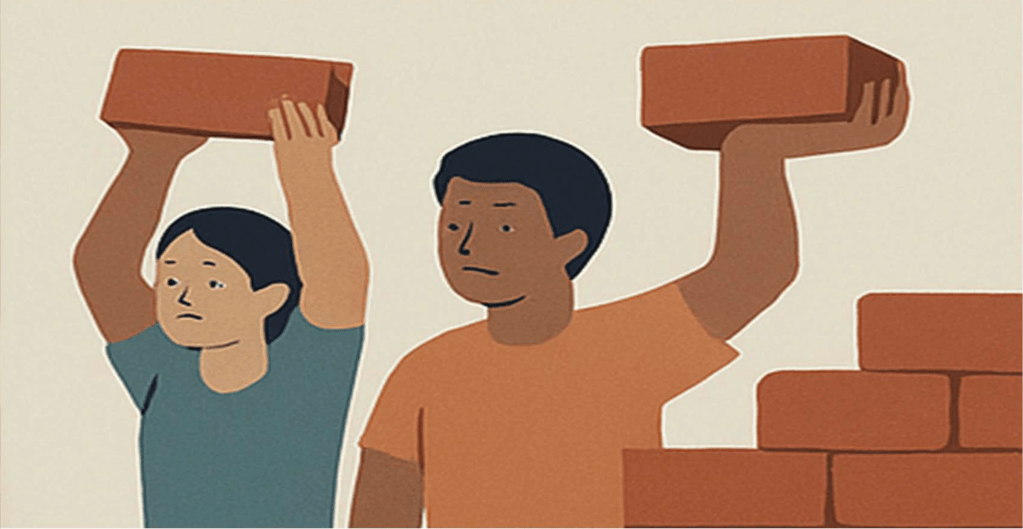
The mental health of immigrants and refugees is a critical public health issue influenced by systemic barriers, acculturative stress, and economic hardship (George et al., 2015). Research highlights that stigma, employment challenges, and discrimination contribute to mental health disparities, preventing many from seeking professional care (Guruge et al., 2016; Ng & Zhang, 2020). Statistics Canada’s findings highlight that immigrant groups display a variety of mental health patterns influenced by their settlement experiences. Statistics Canada’s findings reveal that immigrant groups exhibit a variety of mental health patterns influenced by their settlement experiences. This underscores the urgent need for culturally informed healthcare reforms. To improve mental health outcomes, interventions should aim to reduce stigma, promote economic inclusion, and incorporate culturally sensitive mental health services.
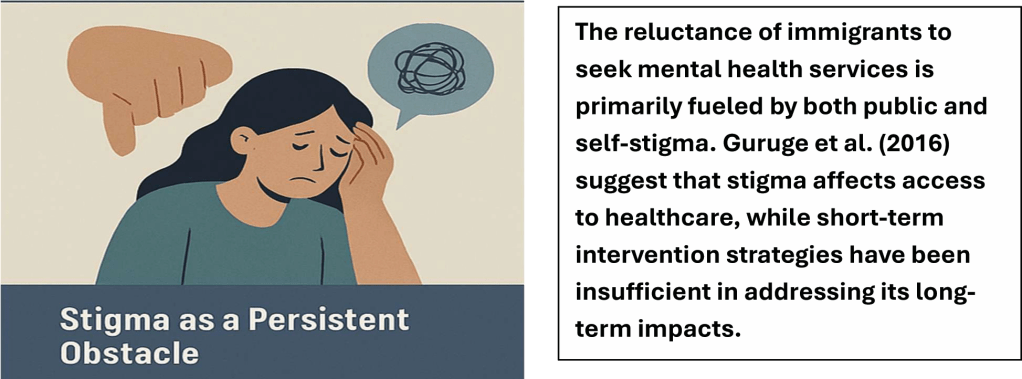
The reluctance of immigrants to seek mental health services is primarily fueled by both public and self-stigma. Guruge et al. (2016) suggest that stigma aAects access to healthcare, while short-term intervention strategies have been insuAicient in addressing its long term impacts.
Additionally, Filipino immigrants, particularly women, often endure heightened distress due to societal expectations and transnational caregiving roles (Straiton et al., 2017). Public health eAorts must normalize mental health discussions through multilingual awareness campaigns, cultural competency training for providers, and peer-driven community outreach (RichestPH, n.d.).
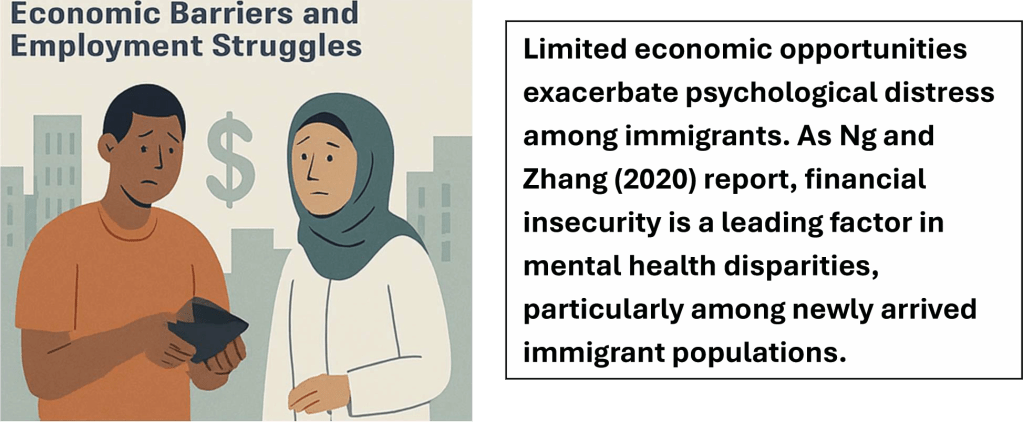
Limited economic opportunities exacerbate psychological distress among immigrants. As Ng and Zhang (2020) report, financial insecurity is a leading factor in mental health disparities, particularly among newly arrived immigrant populations.
For Southeast Asian refugees, exploring Western economic systems while holding on to cultural collectivism creates identity conflicts (Hsu et al., 2004). Without fair employment policies that recognize foreign credentials and provide equitable job opportunities, immigrants continue to face precarious financial circumstances that hinder their overall well-being (George et al., 2015).
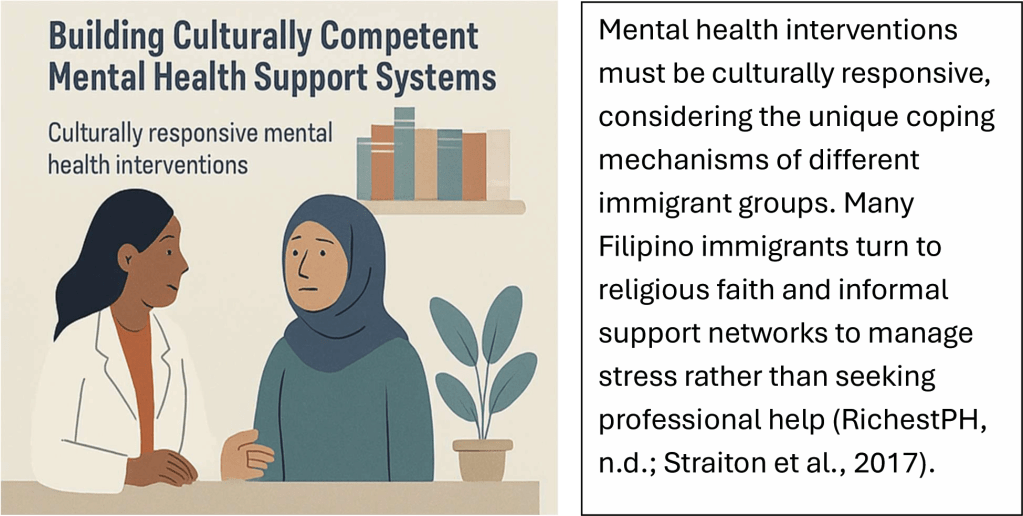
Meanwhile, Southeast Asian refugees benefit most from culturally competent mental health services that integrate traditional healing approaches with Western psychiatric care Limited economic opportunities exacerbate psychological distress among immigrants. As Ng and Zhang (2020) report, financial insecurity is a leading factor in mental health disparities, particularly among newly arrived immigrant populations. Mental health interventions must be culturally responsive, considering the unique coping mechanisms of diAerent immigrant groups. Many Filipino immigrants turn to religious faith and informal support networks to manage stress rather than seeking professional help (RichestPH, n.d.; Straiton et al., 2017). (Hsu et al., 2004). Policy reforms should prioritize bilingual counselling, culturally tailored community programs, and holistic healthcare models to bridge gaps in immigrant mental health access.
Breaking Barriers. Addressing disparities in mental healthcare requires systemic reforms that extend beyond conventional interventions. Initiatives to reduce stigma, improve economic stability, and integrate culturally competent mental health services will foster a more inclusive healthcare environment. By acknowledging the lived experiences of diverse immigrant populations and implementing long-term strategies, public health systems can foster resilience, promote a stronger sense of belongingness, and ensure equitable access to healthcare.
References:
- George, U., Thomson, M. S., Chaze, F., & Guruge, S. (2015). Immigrant mental health, a public health issue: Looking back and moving forward. *International Journal of Environmental Research and Public Health, 12*(10), 13624–13648. https://doi.org/10.3390/ijerph121013624
- Guruge, S., Wang, A. Z. Y., Jayasuriya-Illesinghe, V., & Sidani, S. (2016). Knowing so much, yet knowing so little: A scoping review of interventions that address the stigma of mental illness in the Canadian context. *Psychology Health & Medicine, 22*(5), 507–523. https://doi.org/10.1080/13548506.2016.1191655
- Hsu, E., Davies, C. A., & Hansen, D. J. (2004). Understanding mental health needs of Southeast Asian refugees: Historical, cultural, and contextual challenges. *Clinical Psychology Review, 24*(2), 193–213. https://doi.org/10.1016/j.cpr.2003.10.003
4. Ng, E., & Zhang, H. (2020). The mental health of immigrants and refugees: Canadian evidence from a nationally linked database. *Health Reports, 31*(8), 3-12. Statistics Canada. https://www150.statcan.gc.ca/n1/pub/82-003-x/2020008/article/00001-eng.htm
5. RichestPH. (n.d.). The mental health of migrant Filipinos: Challenges and coping mechanisms. *RichestPH*. Retrieved May 26, 2025, from https://richestph.com/the mental-health-of-migrant-filipinos-challenges-and-coping-mechanisms/
6. Straiton, M. L., Ledesma, H. M. L., & Donnelly, T. T. (2017). A qualitative study of Filipina immigrants’ stress, distress, and coping: The impact of their multiple, transnational roles as women. *BMC Women’s Health, 17*(72). https://doi.org/10.1186/s12905-017-0429-4





 ReyFort Media
Leave a comment